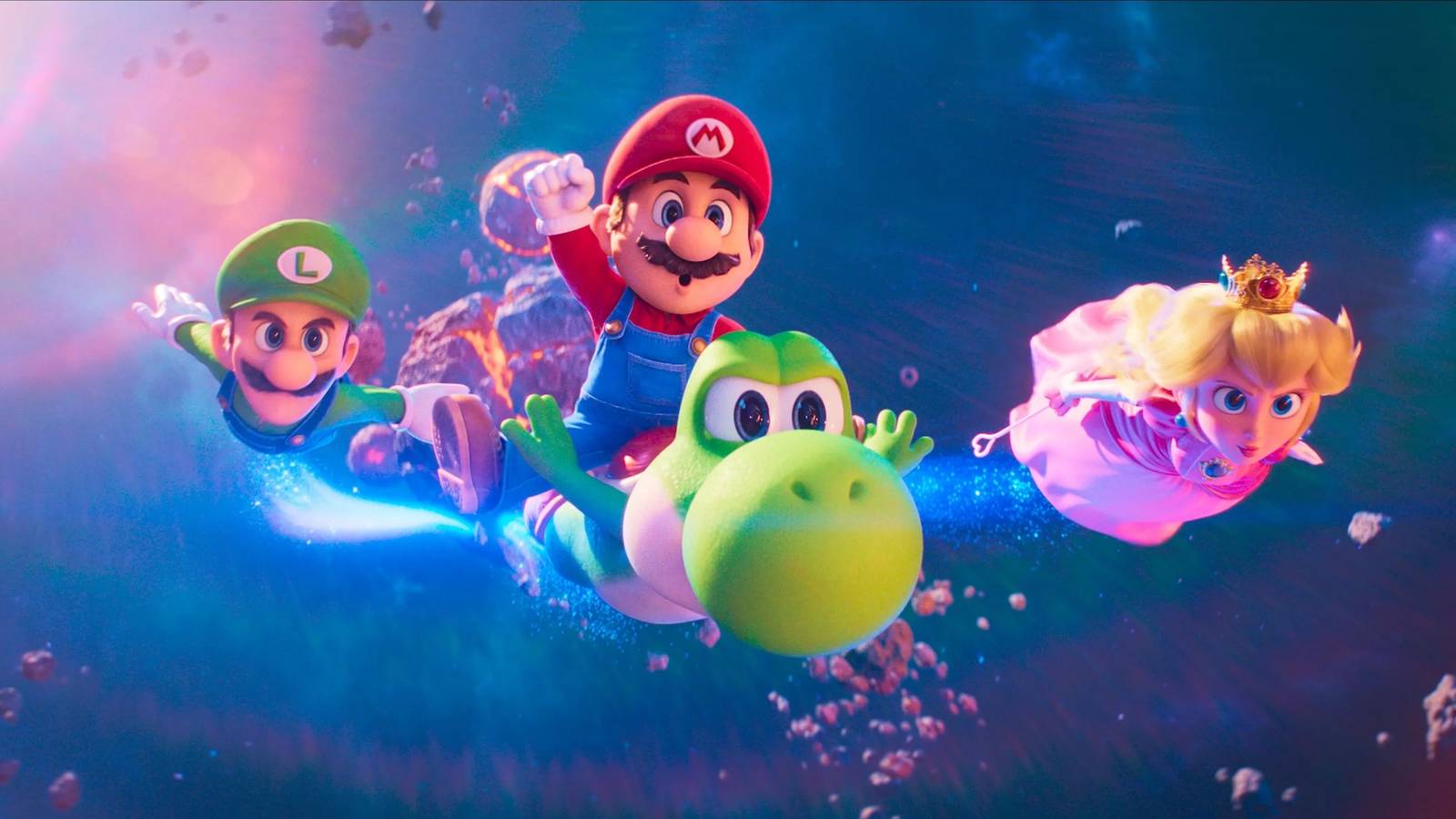
The Super Mario Galaxy Movie marks a big leap forward for Nintendo and Illumination’s animated Super Mario film franchise, as our heroes venture beyond the Mushroom Kingdom and into the realm of deep space. But what comes next in the series may be even bigger, as the moviemakers hint at a further expanded scope for the Mario animated universe.
[Ed. note: Spoilers ahead for the end of The Super Mario Galaxy Movie.]
Does The Super Mario Galaxy Movie have a mid-credits sequence?
At the end of The Super Mario Galaxy Movie, the status quo has largely returned to normal. Mario, Luigi, Peach, and Toad return to the Mushroom Kingdom. Princess Rosalina has been freed from her captors, and reunited with her Luma family. Bowser and Bowser Jr. get their just deserts.
A mid-credits sequence shows Fox McCloud (Glen Powell) and a Toad correctional officer discussing the incarceration of Bowser (now Dry Bowser) and son Bowser Jr., who are serving time in a Mushroom Kingdom prison. Amid banter between the Koopa father and son, Fox offers his goodbyes and sets off on his own adventure.
While Nintendo and Illumination haven’t announced any future movie plans after The Super Mario Galaxy Movie, Fox’s mid-credits appearance will no doubt spur speculation that the companies are setting up a Star Fox spin-off of some sort. Star Fox is a favorite of Mario creator Shigeru Miyamoto; he’s produced and designed multiple Star Fox games over the past three decades, and a new Star Fox game is said to be in the works for Nintendo Switch 2.
Otherwise, the mid-credits sequence offers a fun cameo from the nihilistic Luma known as Lumalee, who was a standout character from The Super Mario Bros. Movie. Lumalee reappears here as a sadistic prison guard obsessed with death, just for giggles.
Does The Super Mario Galaxy Movie have a post-credits sequence?

Yes, and it’s a big one. A brief post-credits sequence returns to the Gateway Galaxy, where Peach and Toad meet Fox McCloud (and Pikmin) earlier in the film. In the post-credits coda, we see an Ukiki once again stealing from a Gateway Galaxy visitor, only to be walloped by the lace-gloved hand of Princess Daisy. While Daisy doesn’t say anything in her Super Mario movie debut (which is not uncommon for these types of teases), it’s clear that Nintendo and Illumination are setting up one more princess to join the cast of a potential third Super Mario movie.
Daisy debuted in 1989’s Super Mario Land for the Game Boy. Daisy is the princess of Sarasaland, an empire that spans four kingdoms distinct from the Mushroom Kingdom. In Super Mario Land, Daisy is kidnapped by an evil space alien named Tatanga, and Mario comes to her rescue. Like Wart, who appears briefly in The Super Mario Galaxy Movie, Tatanga has had little presence in other Super Mario games, beyond his original video game debut.
The addition of Daisy will be a big deal for a subset of Nintendo fans who have strong feelings about the princess, and who often lobby for her to receive more attention. It’s also a big deal for actor Anya Taylor-Joy, who voices Princess Peach in the Super Mario movies, and now wants to see a princess team-up movie.
“I want badass girls saving the world,” Taylor-Joy told Polygon in an interview. “We’re all there, training together. I want all the girls together: three princesses taking care of business.”
Make it happen, Nintendo.

The Easter eggs in the Super Mario Galaxy Movie trailer show the movie’s inspirations go way beyond Galaxy
Nintendo and Illumination are tapping into Mario’s entire modern era
PakarPBN
A Private Blog Network (PBN) is a collection of websites that are controlled by a single individual or organization and used primarily to build backlinks to a “money site” in order to influence its ranking in search engines such as Google. The core idea behind a PBN is based on the importance of backlinks in Google’s ranking algorithm. Since Google views backlinks as signals of authority and trust, some website owners attempt to artificially create these signals through a controlled network of sites.
In a typical PBN setup, the owner acquires expired or aged domains that already have existing authority, backlinks, and history. These domains are rebuilt with new content and hosted separately, often using different IP addresses, hosting providers, themes, and ownership details to make them appear unrelated. Within the content published on these sites, links are strategically placed that point to the main website the owner wants to rank higher. By doing this, the owner attempts to pass link equity (also known as “link juice”) from the PBN sites to the target website.
The purpose of a PBN is to give the impression that the target website is naturally earning links from multiple independent sources. If done effectively, this can temporarily improve keyword rankings, increase organic visibility, and drive more traffic from search results.